
1. Introduction to Long-Tail Keyword Mining
What long-tail keywords are?
Long-tail keywords are longer and more detailed search phrases (usually more than 3 words) that people type into search engines. These keywords usually have lower search volume but less competition and bring more high intent targeted visitors to the website. Modern SEO is all about satisfying search intent. So, long-tail keywords have very high intent of conversion.
Example:
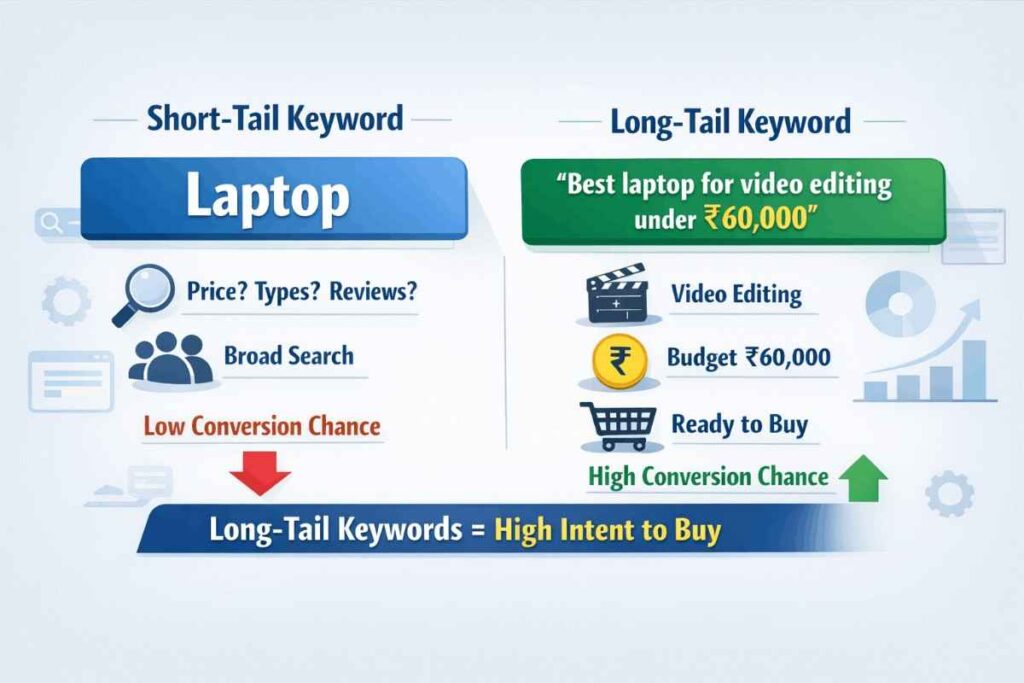
Short-tail keyword: Laptop
Long-tail Keywords: Best laptop for video editing under ₹60,000
Look at the above two keywords:
- The short-tail keywords: The user could be searching for anything like price, types, gaming laptops or other laptops or also, for getting a review. So, this keyword has very low intent of conversion. It can give a large amount of traffic that makes it is very difficult to rank.
- The long-tail keywords: This clearly tells that the person wants a laptop for video editing and their budget is ₹60,000. So, s/he is probably ready to buy or is comparing prices. If the product is good in the market, then this traffic will convert easily.
Why most search traffic comes from long-tail queries?
At first, it may seem confusing. We discussed above that long-tail keywords have low search volume, so it might seem opposite to say that most search traffic comes from long-tail keywords.
However, the explanation is simple. Each individual long-tail keyword has low search volume, but there are millions of different long-tail searches that people type into search engines every day. When all such different queries are combined, they generate a very large portion of total search traffic.
In fact, studies show that about 70 – 90% of all searches on the internet are long-tail queries.
So, while a single long-tail keyword may bring only a small amount of traffic, the huge number of long-tail keywords together provide most of the total search traffic.
The evolution of search behavior
Earlier, people often searched using short and simple keywords like “laptop”. As search engines such as Google improved, users started using longer and more specific queries to find exactly what they need.
For example:
- Short search (Laptop): The user could be looking for anything like price, types, reviews, etc.
- Detailed search (Best laptop for video editing under ₹60,000): This clearly shows the needs and budget of user.
Today, with better search technology and voice search, people prefer more detailed and natural searches, which has increased the importance of long-tail keywords in SEO.
Why modern SEO strategies rely on search data?
Modern SEO strategies mostly rely on search data because it shows what people are actually searching online. By analyzing search data, marketers can understand user needs, search intent, and popular keywords.
For example, if search data shows many people searching for “best laptop for video editing under ₹60,000”, businesses can create content around that topic. This helps them target the right audience, improve rankings, and increase conversions.
2. Understanding Search Data in SEO
Where does search query data comes from?
- User Search Query: When people type something into Google Search, that phrase is a search query. It shows what users want and their intent (learn, buy, compare).
- Clickstream Data: This tracks what users do after searching. It shows which websites they visit, how they move, and what they find useful.
- SERP Behavior: Explains how users interact with search results. It shows which links get clicked, CTR, and user preferences.
- Search Engine Logs: This is internal data stored by Google (searches, clicks, behavior). It includes most accurate data, but it is not fully available to the public.
Below are the some of the popular platforms which collect keyword data:
- Google Search Console: It collects keyword data directly from Google search. It is the real and actual data, but only for your website. It is one of the best platforms to get user query data, specially, for your website.
- Google Keyword Planner: This data comes from Google ads database. It uses aggregated search data from Google users.
- SEMrush: The data source of this platform is Clickstream data, third party data providers, SERP analysis. It is also estimated dataset built from user behavior + tracking system.
- Ahrefs: The data source of this platform is Clickstream data from browsing behavior, their own web crawler and SERP Tracking.
3. The Search Demand Curve
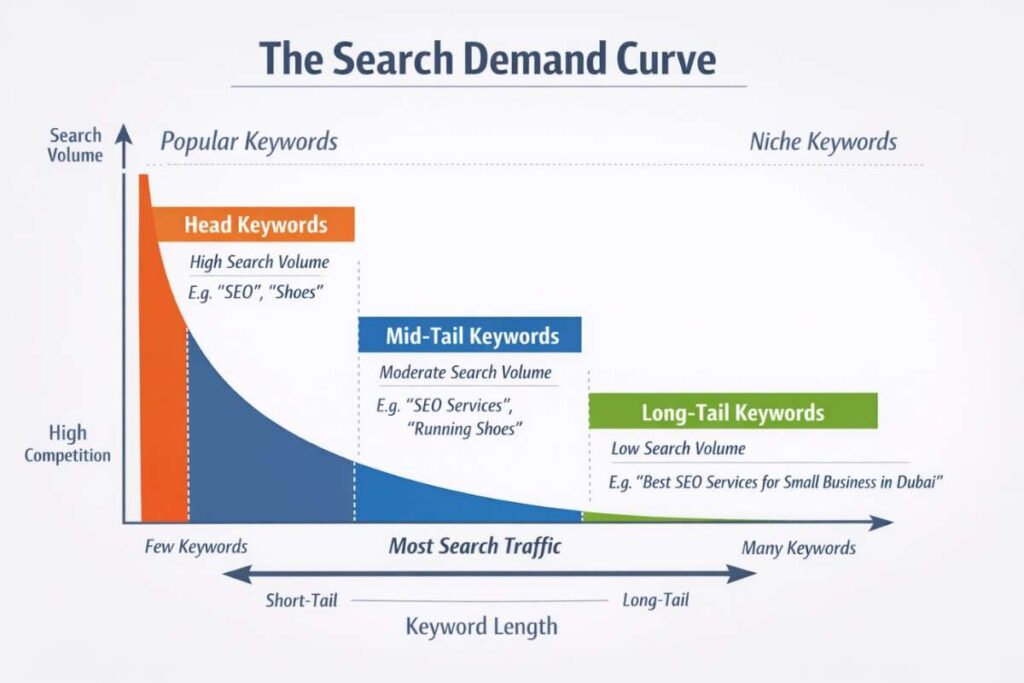
The search demand curve tells us how search queries are distributed from popular keywords to highly specific one. This is also called long-tail search distribution.
Head Keywords: These keywords are very short, one-word keywords having very high search volume and very competitive.
Example:
“SEO”
“Shoes”
Mid-Tail Keywords: These keywords are 2 to 3 words long with moderate search volume and medium competition.
Example:
“SEO services”
“Running Shoes”
Long-Tail-Keywords: These keywords are usually more than 3 words. These keywords have very low search volume and less competition. So, easier to rank.
Example:
“Best SEO services for small business in Dubai”
“Best running shoes under 5000”
Note: There are only a few head keywords, more mid-tail keywords, and a very large number of long-tail keywords. This is why most search traffic comes from long-tail queries.
4. Types of Long-Tail Keywords
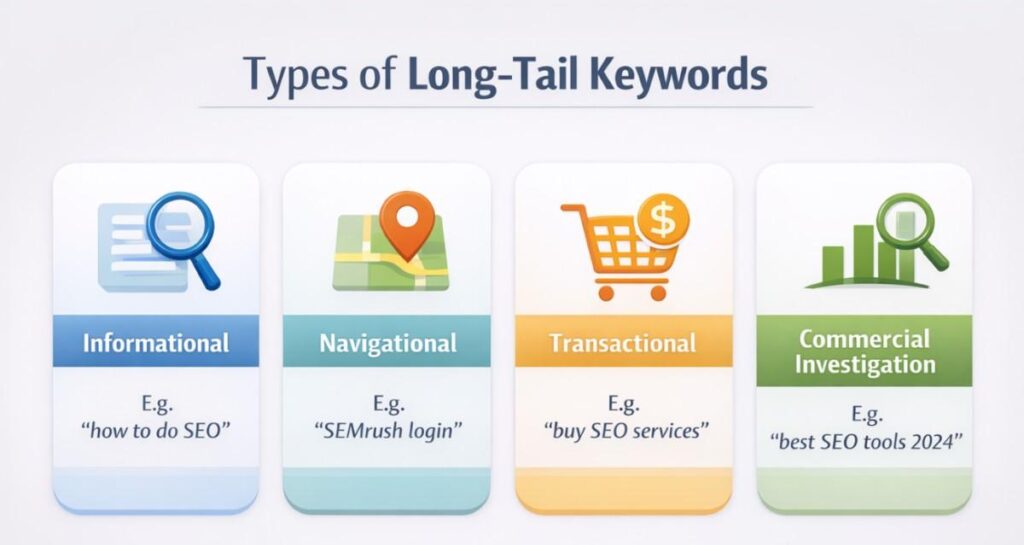
Informational: These keywords are used to learn something.
For example:
- What is SEO?
- How to improve website ranking?
Navigational: These keywords are used to go to a specific website or brand.
For example:
- “Ahref login”
- “Amazon website”
Transactional: These keywords are used to buy or take an action.
For example:
- “SEO packages Dubai”
- “Order running shoes online “
Commercial Investigation: These keywords are generally used by users to compare prices or services before any transactional decision.
For example:
- “Best SEO tool in 2026”
- “Ahref vs SEMrush”
(If you’re enjoying this article, you might like to subscribe to our bi-weekly email newsletter AMPlify. We share new blog articles, videos, and valuable ideas on AI, Marketing and Performance insights to grow your business. We assure you that we will never spam you, sell annoying courses or packages, or bug you with anything non-useful.
5. Sources of Long-Tail Keyword Data
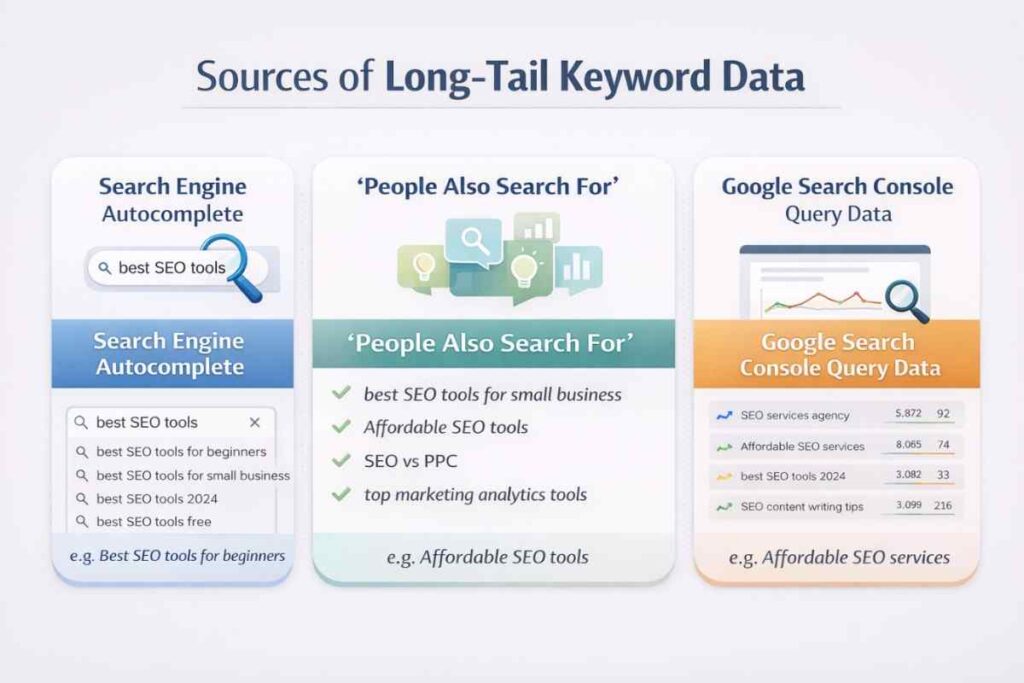
Search engine auto complete: When you type something in Google search, it automatically shows suggestion.
Example:
Typing: “SEO tools”
Suggestion:
- SEO tools free
- SEO tools for Beginners
- SEO tools for small business
All these suggestions are based on real search by the users. It shows popular and trending queries.
People also search for: These keywords shown at the bottom of the search results. Google shows the related searches here.
Google search console query data: This shows actual keywords people used to find your website. Data comes directly from Google users interacting with your site. It helps to find hidden long-tail keywords that is already bringing traffic.
6. Long-Tail Keywords Mining Techniques
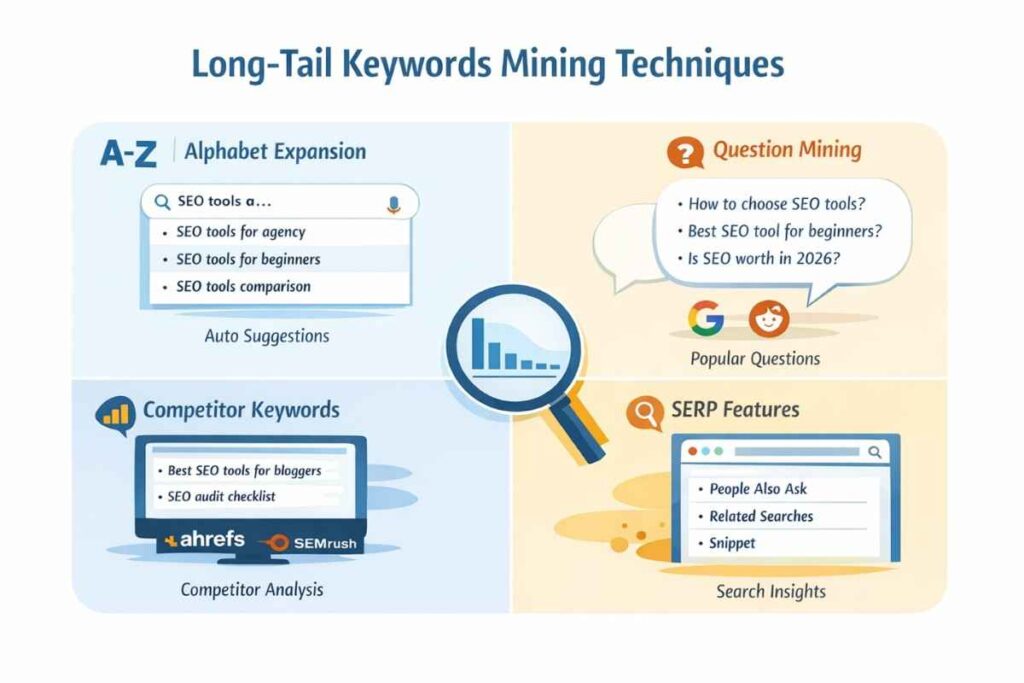
Long-tail keyword mining technique is a process of finding long-tail keywords using search suggestion, questions, competitors and SERP data.
Technique 1
Alphabet Expansion Method: Add a letter (A to Z) just after the main keyword in Google search box. You will see the suggestions below as a dropdown.
Example:
Main Keyword: ‘SEO tool’
Try
- SEO tools a >> SEO tools for agency
- SEO tools b >> SEO tools for beginners
- SEO tools c >> SEO tools comparison
By using this technique, you can easily find the long-tail keyword variations quickly. These long-tail keywords are the real search phrases.
Technique 2
Question Mining: This technique is used to find questions people ask on different platforms like Google, Forums like Reddit and QA platforms.
Example:
- How to choose SEO tools?
- Which SEO tool is best for beginners?
- Is SEO worth in 2026?
Note: These keywords are best for blog content and to target informational intent.
Technique 3
Competitor keyword mining: This technique is used to find those keywords on which your competitors ranking on:
Tools used:
- Ahref
- SEMrush
Example:
Competitors rank for:
- “Best SEO tools for bloggers”
- “SEO audit checklists for beginners”
These are proven keywords which help you discover the gaps in your content
Technique 4
SERP Feature mining: This is the technique for finding long-tail keywords from SERP.
On Google search look for:
- People also ask
- Related search
- Featured snippets
It provides real-term search data
7. Keywords Clustering and Topic Modeling
Modern SEO is not about targeting one keyword per page. Now, modern search engines like Google use semantic analysis to understand the meaning of the content and relation with the keywords in the content. This gave birth to Semantic SEO.
What is Semantic SEO?
It is the process of grouping related keywords based on intent and meaning, not just exact keyword.
Example:
“technical SEO tools”
“technical SEO checklists”
“technical SEO Audit”
All the above keywords belong to the same topic: Technical SEO
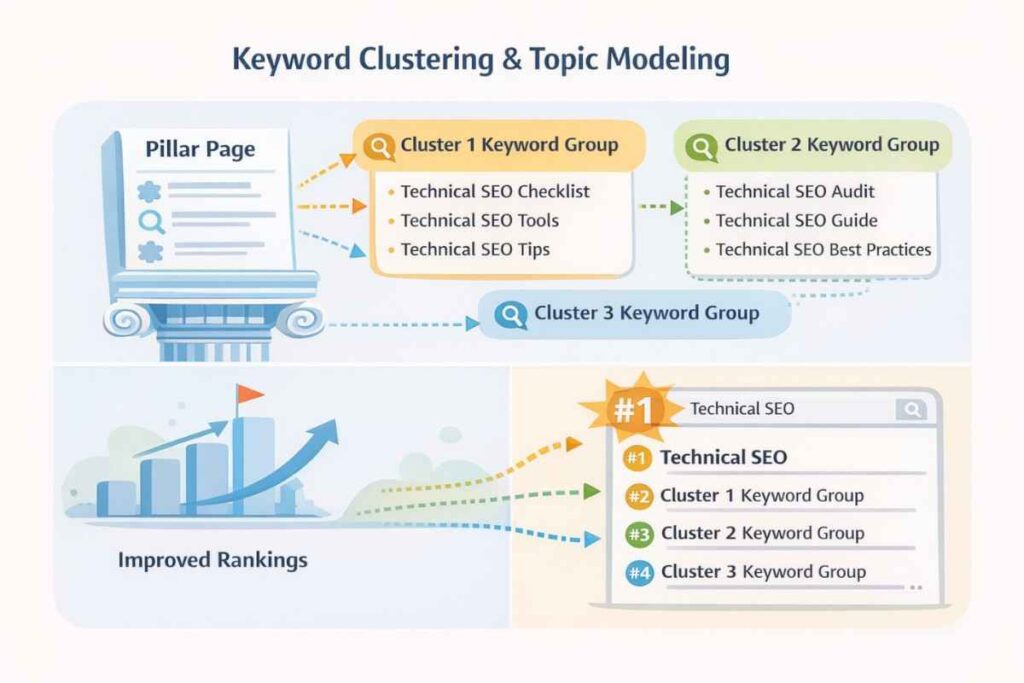
Keyword Clustering: It is the process of grouping similar keywords together.
Example:
Main topic: Technical SEO
Cluster Keywords:
- technical SEO tools
- Technical SEO checklists
- technical SEO Audit
Instead of creating 3 different pages, you should create a single strong page using above cluster keywords and the main keyword.
Topic Cluster: It is a process of grouping related content around one main topic.
Structure:
- One main topic
- Multiple supporting articles
Example:
Main topic: Technical SEO
- Article 1: Technical SEO checklist
- Article 2: Technical SEO tools
- Article 3: Technical SEO Audit Guide
All articles are interlinked.
Pillar Pages: It is a main comprehensive page covering core topic.
Example:
Pillar page: “Complete guide to technical SEO”
It links to:
- Technical SEO checklist
- Technical SEO tools
- Technical SEO audit
It acts as central hub.
Note: Keywords Clustering and Topic Modeling helps rank for multiple keywords, build topic authority and improve user experience.
8. Building Long-Tail Keyword Strategy
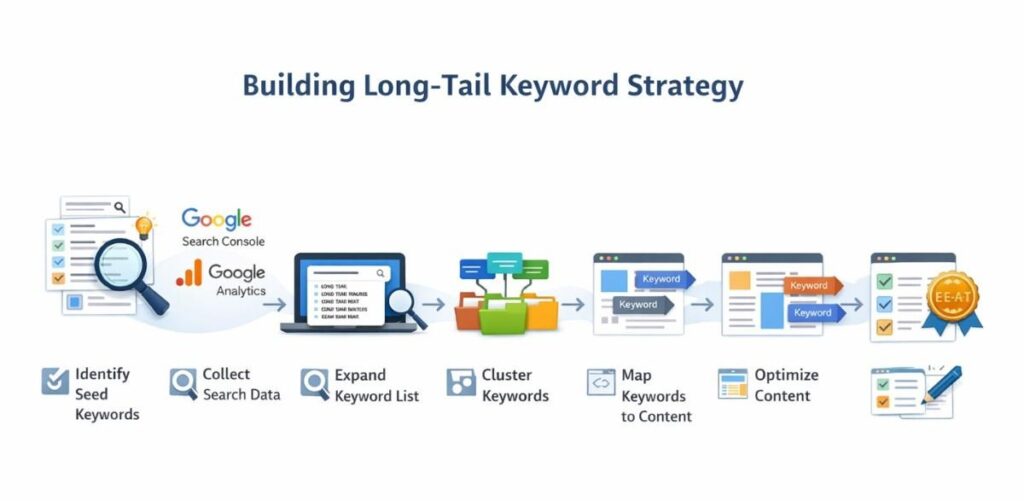
- Identify seed keywords: Start with basic keyword related to your business.
- Collect search data: Collect search data using Google search console and Google analytics.
- Expand keyword list: Turn seed keywords into long-tail keywords using Google autocomplete, related seach and competitor analysis.
- Cluster keywords: Group similar keywords together.
- Map keywords to content: Assign each cluster to a page.
- Optimize content structure: Create high quality valuable E-E-A-T Compliance content.
9. Common Mistakes in Long-Tail Keyword Research
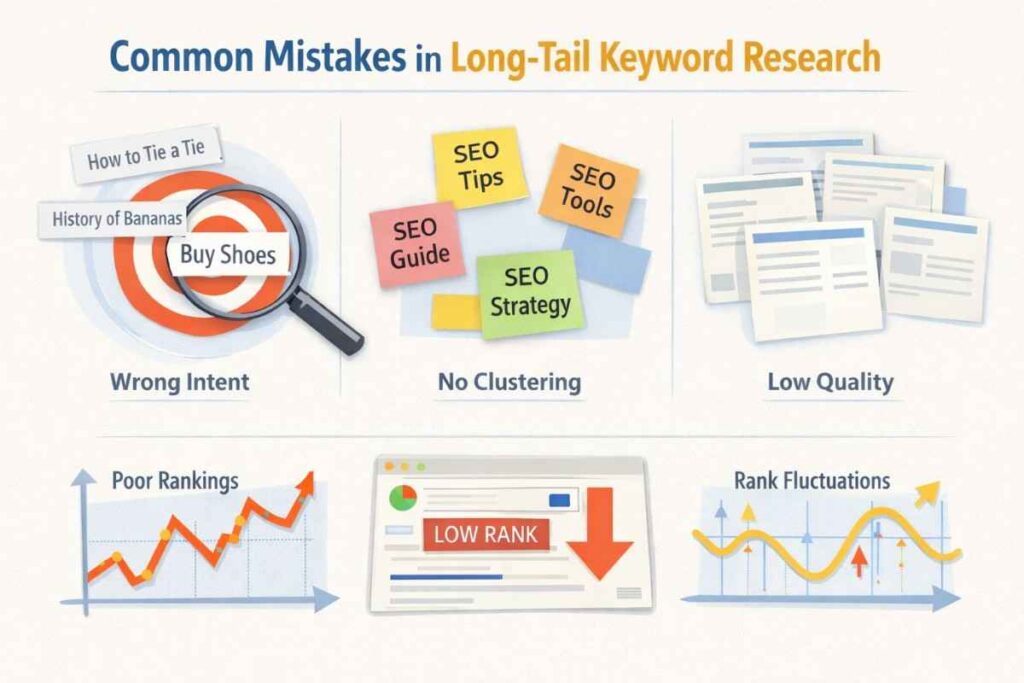
Below are the some of the most common mistakes which can reduce SEO performance. These mistakes confuse search engines and fail to satisfy user intent.
- Targeting keywords without search intent
- Ignoring keywords clustering
- Creating thin pages for each keyword
If your content does not match user intent, lack of depth and not structured properly. It will struggle to rank higher on the search engine. Such rankings never become stable. It will fluctuate with time.
10. Future of Long-Tail Keyword Research
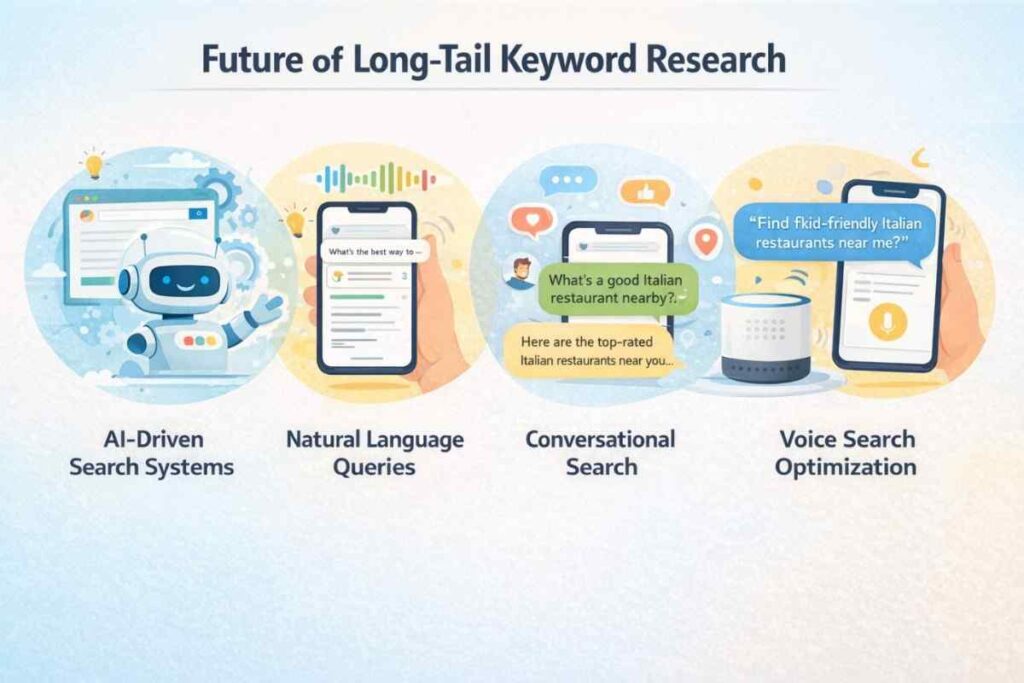
Search systems are rapidly evolving due to AI and smart search algorithms. Long-tail keywords are hence becoming more important as people are now searching the web in a natural, conversational way.
Below are some of the top key trends which are shaping the future of long-tail keywords:
- AI driven search systems: Search engines now uses AI to understand search intent and then find the best result based on this intent.
- Natural language query: Users now search like they speak. Their search term is longer and more natural. So, use of long-tail keywords increases day by day.
- Conversational Search: Now search is becoming like a conversation, like follow-up questions, context-based answers, multi-step queries.
- Voice search optimization: With voice assistance, people speak full sentence. So, optimizing for natural language is essential.
Conclusion:
- Long-tail keywords drive the majority of organic search traffic.
- Search data reveals user intent clearly
- Clustering and semantic SEO strategies are essential these days.
Successful SEO strategies focus on capturing thousands of high intent long-tail searches instead of a few high-volume search keywords